.png)


2026 Update of Illinois Cottage Food Guide Now Available

Current/Would-Be Producers Can Access on Illinois Farmers Market Association Site
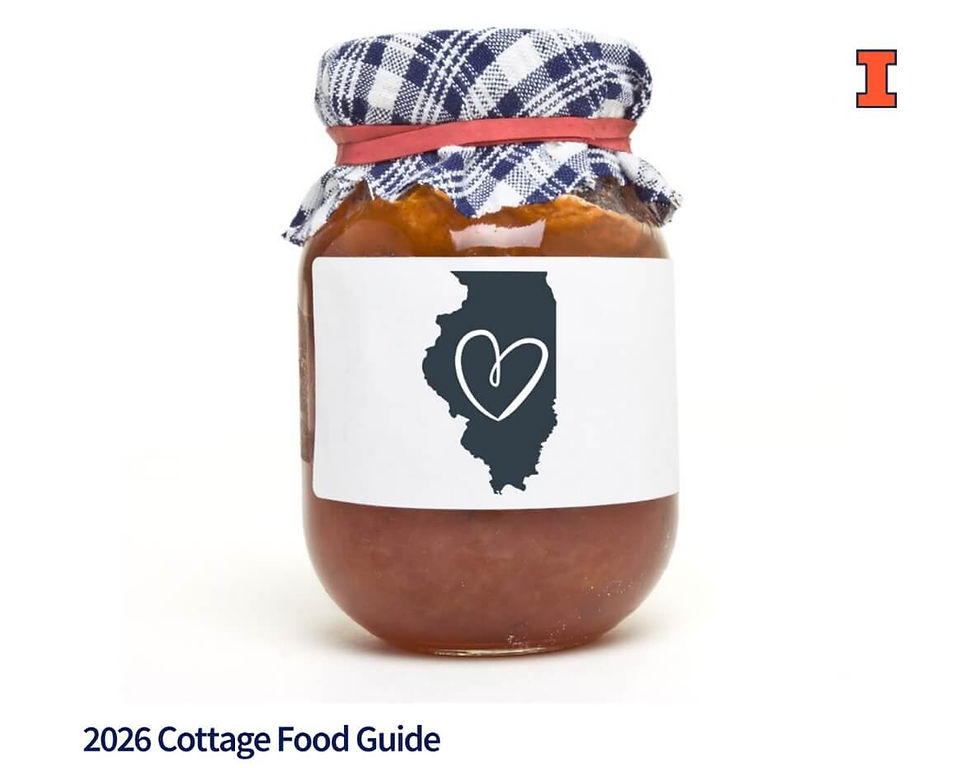
Illinois' Cottage Food Law provides opportunities for talented home cooks and bakers to create small-scale food businesses at home without building or renting space at a commercially licensed kitchen — as long as their products meet regulatory requirements focused on food safety.
If you are considering a cottage food business or want a refresher on the dos and don'ts, you can download a copy of the 2026 Cottage Food Guide from the website of the Illinois Farmers Market Association (ILFMA) or Illinois Extension.
Libby Ervin, recently installed as ILFMA's executive director, played a key role in expanding the state's Cottage Food Law. She and her husband Derek had established a cottage food business making hot sauces, vinegars, syrups and other items from produce they had harvested or foraged on their Glacier's End farm in far southern Illinois, but were frustrated by legal restrictions that required cottage producers to sell only at farmers markets.
Libby became a leading advocate in the campaign that persuaded state lawmakers in 2021 to expand cottage food sales to a wider range of events, by home delivery, and through e-commerce. She and Derek are also exemplars in how cottage food can lead to bigger success, as they segued into a brick-and-mortar Glacier's End business with a commercial kitchen in Marion, Illinois.
The Cottage Food Guide is a collaboration of University of Illinois Extension, Illinois Department of Public Health (IDPH), Illinois Stewardship Alliance, and additional statewide partners. The following is the description of cottage food provided in the guide's preface:
As defined in Illinois law, a “Cottage Food Operation” means an operation conducted by a person who produces or packages food or drink, other than foods and drinks listed as prohibited in the law, in a kitchen located in that person’s primary domestic residence or another appropriately designed and equipped kitchen on a farm for direct sale by the owner, a family member, or employee. In other words, a Cottage Food Operation is a home-based food business.
The Cottage Food Law was created with the intent of supporting the growth of small businesses by creating regulations that allow food entrepreneurs to use their home kitchens to make certain, relatively low-risk food products for sale directly to consumers. Cottage food operations are not intended to compete with brick-and-mortar establishments and are limited in the type of products they can make, the places they can sell their products, and by additional labeling and signage not required of commercially licensed food establishments.
The Cottage Food Law provides food entrepreneurs with the opportunity to start small, test their products, and grow a customer base before deciding whether or not to scale into a commercial kitchen.
The Cottage Food Law allows a broad range of low-risk food products, as well as some higher risk food products that have additional requirements. Prohibited ingredients or products, as outlinedby the law, may not be produced by a cottage food operation. All food or drink produced in a cottage food operation must physically be altered or processed.
All sales must be direct-to-customer. This can be done by either the owner, a family member, or an employee, all of whom must be listed on the Cottage Food Operator Registration Form. Cottage food products may not be repacked, sold, or distributed by a third party.
Learn more by accessing the Guide.


Comments