.png)


North Stars: Musician-Champions of Family Farmers for 41 Years

Founders of Farm Aid and What They Said at Its 2026 Festival
I attended my first Farm Aid Festival in 2015 when the musician-driven nonprofit brought its advocacy for family farmers and a better food system to Chicago to celebrate its 30th anniversary. I returned in 2023 when the Festival was held outside Indianapolis — and I found the event so inspiring, so immersive, such a gathering of like-minded people that I decided that as long as I am physically able, I will attend this event every year.
My trip east to Virginia Beach last week for Farm Aid 2026 marked the fourth year in my streak. I've written extensively about each year's event, and I suppose there are some readers who think, "So Bob took a vacation and went to a concert. Big whoop." That is a misunderstanding of what Farm Aid is about and why I go.
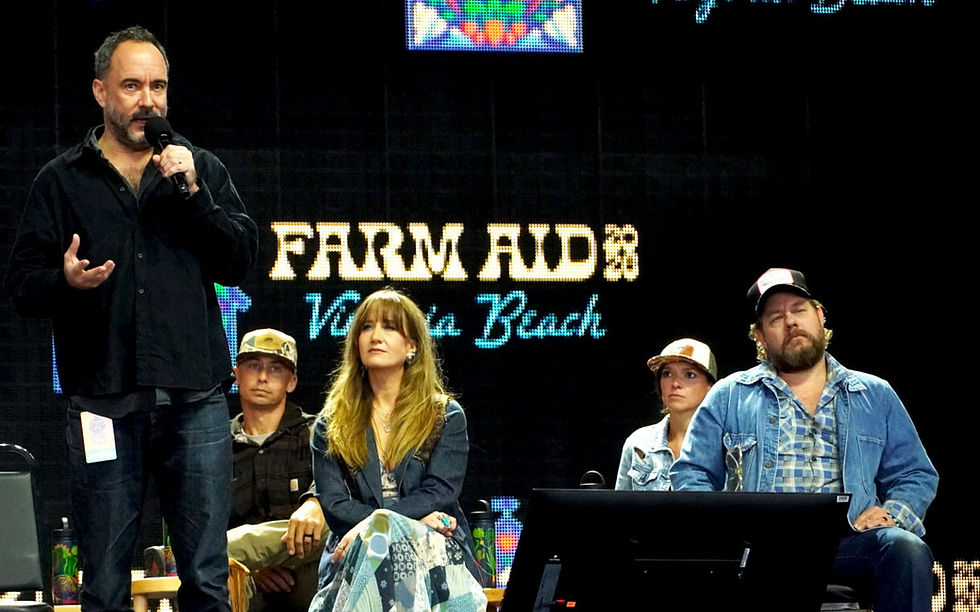
Yes, of course, the centerpiece of the Festival is a talent-loaded concert that typically lasts for about 12 hours and is capped by appearances by Willie Nelson, Neil Young and John Mellencamp, who founded Farm Aid in 1985 in the midst of a searing farm crisis, and fellow musician Board members Dave Matthews, Margo Price and Nathaniel Ratlieff.
I'll be sharing that side too as the kind folks of Farm Aid provide me with pit privileges in front of the stage because I do my own photography for this scrappy little publication.
But there is a ton of content too, with the existential challenges, needs and hopes of the nation's diminished community of independent family farmers aired from the Festival stage, the Homegrown Village exhibition of dozens of farm and food non-profits, the Farmstand tent where panel discussions are held, and several side events.
This is, in fact, a critical year, described by numerous speakers as the worst since the 1980s farm crisis, as longstanding issues — the high cost of land, climate change, the consolidation of farmland in fewer and fewer hands, the political and economic clout of the barons of the conventional food system — are layered upon by new burdens, such as the decline in exports resulting from Trump's trade wars, the soaring price of fertilizer and fuel because of the war he started in the Middle East, and the technology industry's push to buy up farmland to build data centers.
Over the following days, I'll be writing about a number of topical talks and discussions. For starters, I turn to the press event, held on the stage of the Festival arena each year just prior to the concert.
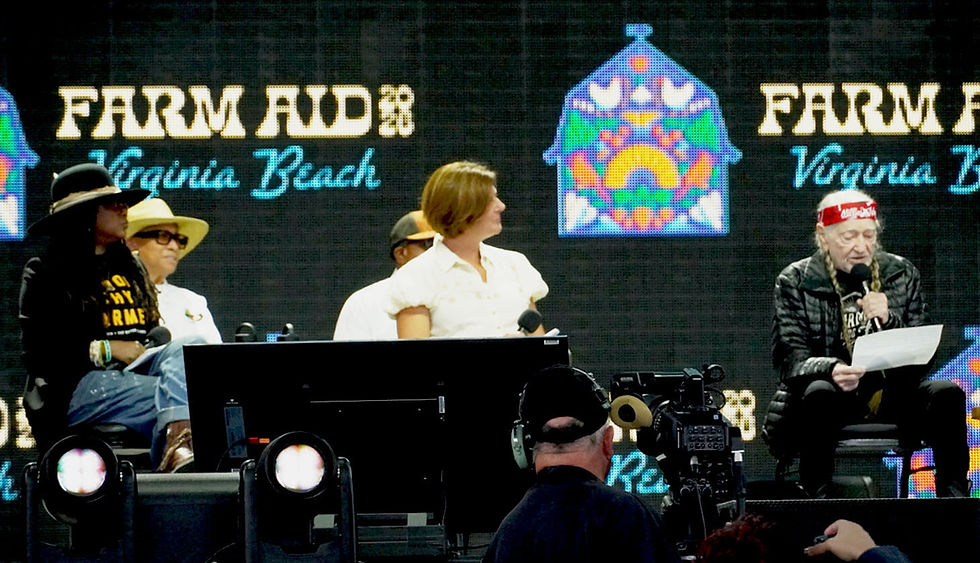
The event unfolds with videos and interviews of farmers from the surrounding region talking about their journeys, challenges and joys. After each "farmer hero" segment, a musician-member of the Board makes a statement.
This article will share the words of the three co-founders. Next up will be thought-proving statements from the other Board members. I'll wrap this up by introducing those farmer heros.
Willie Nelson

Willie Nelson grew up in Texas farm country and belonged to Future Farmers of America when he was young. His lifelong sympathies for family farmers prompted him to reach out to fellow activists Neil Young and John Mellencamp to hold the first Farm Aid concert in 1985 at the University of Illinois' stadium in Champaign.
Willie turned 93 in April and isn't one for making long speeches, so he provide a short welcome to attendees:
Thank you all for coming to Farm Aid 2026. We started Farm Aid 41 years ago, because we saw small family farms disappearing, and we find ourselves in that situation yet again.
Neil Young

Now 80 years old, Neil Young has been outspoken on political, environmental, social and of course farming issues since he emerged as a music star. He performed on Buffalo Springfield's "For What It's Worth," a keystone song about the social unrest of the 1960s. In 1970, he wrote and sang lead on "Ohio," a protest song about the killings of four students by National Guardsman at Kent State University; that same year, he released "After the Goldrush" with the lyric, "Look at Mother Nature on the run in the nineteen-seventies." In 2015, he wrote an entire album lambasting Monsanto, the producer of agricultural chemicals and GMO seeds that is now owned by Bayer.
His speech at Farm Aid 2026 emphasized his call to vote for changes that are positive for farmers and the environment:
I have to say, farmers are the soul of America. I believe that because they're on the land, and as we cruise around playing our concerts over the last 50 or 60 years in our busses and trucks and everything, we see a lot of farmers, and sometimes we get to talk to them and talk to their families. And I remember one farmer's wife saying how scared she was when she was out hanging the laundry because everything was changing and the crops weren't like they were before, and they could feel that something was happening.
And out on the farm, out on the land, out in America, the farmers are the ones who see it coming first. They're the ones who are out there in it. They're not inside a city. They're not anywhere else. They're out in America, in the world, and they can feel the wind blowing like we can feel this breeze coming in here, and every once in a while it's a big gust.
That's the future. If we look down the road, science is telling us today that the worst things that are happening with our weather, where the temperatures are really high and it's getting really hard for things to happen, and things are not the same as they were before for farmers, for everybody. They're telling us this, and then they're saying in 20 years, science is saying in 20 years this will be normal if we don't change our direction, and that is a problem that we have with the vision and leadership in America. We have no direction.
Farmers get the first glimpse. They can see it coming. They feel it. They may not articulate it the same way as someone else will, but they're the ones on the front lines. They're the ones who are really the real people that are feeling what America is being hit with and going to be hit with this climate thing is huge. We need real leadership.
So what this gets around to is every farmer, everybody who knows a farmer, everybody who eats food should vote because that's where we are. We're in America and we're in the world, and we can still lead if we lead, if we stand up and make change. Because our vision that we have in government is taking us in the wrong direction, and you can see it out in the fields. You can feel it coming. You can feel it in the wind. When you listen to the scientists, don't just disparage them as to the fact that they're well, they you know, the scientists — they are studying what's going on, and they see what's happening.
We are under a huge threat, and we're right here. And what we feel, and everybody's talking about the things that are happening that we can deal with day to day. And they're the thing; they're real things, and I feel it for everyone who has mentioned that out here, but they're all part of a bigger picture that we need to address in a very big way and make change of direction and vision.
And we need to back off on our fossil fuels completely. I'm saying it's very unpopular to think of doing that, but if a politician had the balls to stand up and say we have to stop that, maybe they wouldn't even get elected. Maybe they'd get thrown out of office for saying that. That where we're at because it's unpopular.
Climate change moves so slow that today's fast thinkers can't see it. You can't see what's happening because it's not happening today. It's not happening tomorrow. But it is. It's happening so slowly over time that we we're missing it. We have to get a grip on it.
And please, all farmers in the world, vote. Vote for change in your country. Vote for what we need, what our families need, what our children need. What about the seven generations that are coming? What about them? Farmers can see this.
Farmers are the soul of America. They're on the front lines, and they see it and they feel it. More important, they feel it. So I'm just recognizing you for what you're going through and what is so hard to articulate, and what you feel when you go out into the field, and what you feel when you're driving down your long road into your place, and what you feel when you see your neighbors from maybe a mile or two away, and you see them. You look in their eyes, and you can see that they feel the same way you do. That they just can't articulate it.
So please, farmers, continue doing what you're doing, and do it with all your heart. And please be together, and please vote for America.
John Mellencamp

A native of the southern Indiana city of Seymour, John Mellencamp has taken the posture of a small-town "heartland rock" populist since he emerged in the early 1980s as John Cougar (a monicker slapped on him by his agent). He already had big hits with socially edgy songs such as Pink Houses, Crumblin' Down and Authority Song when, in 1985, he released Rain on the Scarecrow, seeking to draw attention to the devastation being wreaked on family farmers by the economic crisis of the 1980s. A few months later, he joined Willie Nelson and Neil Young in launching Farm Aid.
Now 74 and the youngest of the founders, here's what John Mellencamp had to say.
I just want to start out by saying that, and this is going to seem weird to everybody, but Texas and Oklahoma and all those cities and those states that we took from Mexico, we paid four and a half cents an acre for that land. Think about that. Think how many years ago that was.
I think about us guys getting farming together and being so naive that we thought we could do a couple concerts and they would see the error in their ways and and try to help people who need help. But goddamn it, we're Americans and we should stick together. We should not be divided by politicians, race, creed, whatever religion.
I mean there is so much to be grateful for, and so much to be happy for, unless you're a farmer sitting there going, "Hey, this commodity says this. Should we sell now? Are we ever going to sell?"
It's really hard to be a to be a farmer. You know I just want to try to send out a a positive message to everyone that we're not the first bunch of people to go through this. This has been going on as long as there've been white Americans running this world.

Comments