.png)


Food and the Black Experience Explored by Obama Center Panel

Updated: Aug 26
Chefs and a Historian Reminded That Food is a Way People Carry Home with Them

From BBQ to collard greens, fried chicken to gumbo, shrimp and grits to red beans and rice, and so much more, Black Americans have made massive contributions to this nation’s culinary palette. Millions of people enjoy these foods... many without acknowledging how these dishes originated in the centuries of oppression, deprivation and necessity endured by Black people.
This background adds relevance to the first major food-related event at the recently opened Obama Presidential Center on Chicago’s South Side. “Food and the American Story,” which took place in the Center’s Forum building on Saturday (August 22), featured a panel discussion and tasting event.
The program — part of the Center’s “You Are America” series commemorating the nation’s 250th anniversary — brought together five Black culinary voices with distinctly different perspectives, but a remarkably consistent message: Food is never just food. It is memory, migration, culture, survival, creativity and connection.

The panel was moderated by Erick Williams, the James Beard Award-winning chef-owner of Virtue, his acclaimed Hyde Park restaurant where he interprets Black Southern cuisine, and Daisy’s Po-Boy, his casual restaurant across the street that is rooted in New Orleans cooking.
Joining him were chefs Cliff Rome of Chicago and Matthew Raiford of Brunswick, Georgia; Maya-Camille Broussard, the pastry chef/owner of Chicago’s Justice of the Pies and a James Beard Award finalist for Best Baker; and Adrian Miller, the cultural historian and James Beard Award winning author known as “The Soul Food Scholar.”

Matthew Fulle, the Obama Center’s manager of strategy and design for programs, opened the evening by framing food as a vehicle for understanding both individual and collective stories. Food, Matthew said, allows us to share “where we call home, our values, and our lived experiences.” It can also connect people across differences and help tell the story of America.
That set the stage for a conversation that moved easily between the personal and the historical.
Foodways That Accompanied the Great Migration

Adrian Miller, author of the award-winning 2013 book Soul Food, offered one of the evening’s central ideas. Soul food is, in his view, the cuisine of the millions of Blacks who left the Jim Crow South during the Great Migration — the mass movement of people seeking economic opportunity and freedom from repression.
Adrian described soul food as the result of West African, European and Indigenous American influences coming together in the American South, followed by the introduction of that cuisine to other parts of the country.
His supposition is straightforward but illuminating: The food became “soul food” when it left the South and arrived somewhere else. “When you get to the new place, you try to recreate home,” he explained.
He explained that this is rarely an exact process. Some ingredients in the migrants’ new homes were unavailable, making substitutions necessary. Greens that might have been available in abundance in the rural South became limited to collards, kale, mustard or turnip greens in an urban Northern environment. New neighbors and broader cultural influences introduced new foods and techniques. Recipes changed.
The result was adaptation — and ingenuity. In that sense, the Great Migration transformed Southern cooking while also helping preserve it.
Chef/Farmer’s Southern Connection Never Diminished

Matthew Raiford brought a different perspective to the migration story. His family, he said, never really left the South: A sixth-generation descendant of Jupiter Gilliard, who purchased 476 acres of land in 1874, Raiford is the steward of a family farm in Brunswick, Georgia. His son represents the seventh generation.
That connection to land has given him a different understanding of what “home” means: “My people ain't never left the South. And if you got any of your family that's in the South, you just have to be up here [in the North]. You still got family at home. What do you call it when you go south? I'm going to see my grandma back home.”
He added, “I think that that's the one thing that a lot of people in the North have forgotten is that they don't have to come home every time they use that fork to eat. They go home. Never left.”
It is easy to lose sight of this reality amid the familiar narrative of the Great Migration. Chicagoans whose parents or grandparents came North did not necessarily sever their relationship with the South. They carried Southern culture with them, and often continued returning to it.
A People’s Culture Baked in a Pie

Maya-Camille Broussard, recognized locally and nationally for her baking prowess, knows that story personally. A second-generation Great Migration Chicagoan, her family roots extend to Anderson, South Carolina; Macon, Georgia; Lake Charles, Louisiana; and Tennessee.
Growing up in Chicago, she did not always recognize the Southern origins of the foods surrounding her. She recalled thinking that baked spaghetti — including the cheesy version often associated with Chicago fish fries — was a Chicago creation. Later she learned that the dish had roots in Tennessee.
That realization is part of what makes food history so fascinating. Cultural traditions can become so thoroughly embedded in a new place that their origins disappear from view.
Food as Memory in a South Side Restaurant

Cliff Rome grew up in the Englewood neighborhood and his deep roots in Chicago’s food culture led to his appointment as executive chef and director of food services at the Obama Presidential Center — a role that puts him in charge of Talati’s Restaurant at the Center.
During the panel discussion, Cliff connected the Great Migration story to a much more intimate place: his grandmother’s kitchen. He began cooking there as a child, learning not only how to prepare food but also the importance of family conversations and the lessons that emerge when people gather around a table.
Those lessons became part of his culinary career. Cliff returned to the South Side after building a career that took him beyond Chicago. He created restaurants and culinary programs. And at his Peach’s Restaurant, he deliberately recreated something of his grandmother’s kitchen.
There is a table in the restaurant that he calls “Table 37.” It represents his grandmother’s kitchen table, where greens were picked, bills were paid, prayers were said, people were reprimanded and people were celebrated.
That is what Cliff wants his restaurants to provide: not simply a place to eat, but a place where people can gather and build memories.
He spoke of historic Black restaurants — Gladys’, Izola’s, Army & Lou’s and MacArthur’s — as Chicago institutions that served as community cornerstones. He wants Peach’s to become one as well.
For Cliff, returning to the South Side was a conscious decision to invest in a community with extraordinary historical and cultural depth. And that investment extends beyond restaurants. His culinary hospitality programming is designed to help develop people as well as businesses.

Recipes Not Written Down But Never Forgotten
One of the evening’s most compelling discussions centered on recipes that were never written down.
Erick raised the possibility that the refusal by some Black forebears to write down recipes may have been, in part, a form of resistance. Enslaved people were deliberately denied literacy, and the knowledge passed through generations therefore often traveled orally and through observation.
Maya described learning from an aunt who would promise to give her recipes but rarely provided anything written. “You have to watch me,” she recalled her aunt saying. There were no precise measurements. You watched the process. You learned the visual cues. You knew when something looked right.
And sometimes, the most important part was not the recipe at all. “It’s the secret,” Maya said. She discovered one of her aunt’s secrets for candied yams was frozen orange juice concentrate. The unexpected ingredient made perfect sense once she knew it.
That is often how family food traditions work. The recipe is only part of the story. The knowledge lies in the technique, the substitutions, the circumstances and the person teaching you.
Maya also spoke about her late father Stephen Broussard, a criminal defense lawyer, whose apple-cranberry pie was remembered by people who knew him. They would ask her for the recipe, but she did not have it.
That missing recipe did not prevent her in 2014 from creating Justice of the Pies, so named in his memory. She created her own recipe and it became part of her own culinary story.
Food Stories Not Always Told by Those Who Lived Them
Adrian has spent years recovering stories that were either forgotten or told through somebody else’s lens. His books have explored the history of soul food, Black chefs in the White House and African American barbecue, among other subjects. He described his work as rediscovering stories that were once told and bringing them to contemporary audiences.
He invoked an old African proverb about the lion and the hunter: Until the lion has its own storyteller, the hunter will continue to be the hero.
For Adrian, Black Americans now have more opportunities than ever to tell their own stories. Social media and other digital platforms have weakened some traditional gatekeepers who determined which stories received attention.
That matters because even the historical record can be complicated. Adrian has read thousands of narratives collected from formerly enslaved people during the Depression-era Federal Writers’ Project of the 1930s. Those oral histories provide extraordinary insights into the lives of formerly enslaved Americans, but they were often gathered by white interviewers, creating another layer of complexity.
Within those accounts, however, Adrian sees something profound. Enslaved people experienced food as an instrument of control used against them. Access to food could be manipulated, restricted and used as a means of punishment.
And yet, culinary traditions emerged that are now enjoyed around the world. That, Adrian suggested, is a story of resilience and creativity.
He also believes Black Americans have an opportunity to connect their food traditions to a global cultural influence that is already widely recognized in music, dance, entertainment, fashion and language. Food is part of that story too.
The Shadow of the Chicken Bone Trail
Matthew — who describes himself with the portmanteau “CheFarmer” offered perhaps the evening’s most striking reminder that food traditions can be shaped by circumstances that are difficult for contemporary audiences to imagine.
He recalled traveling as a child between Georgia and the North and the precautions Black families had to take on the road. The “chicken bone trail” referred to the practice of throwing chicken bones out of the car window after eating.
Why? Because stopping could be dangerous. If a Black family was stopped by authorities or encountered hostility, food in the car could be taken. So families ate on the road and disposed of the evidence.
Matthew emphasized that these were not stories from some distant historical era. He turns 59 this week, and the experiences he was describing took place roughly 40 years ago. That proximity gives the history a different weight.
He also discussed the development of the interstate highway system and the ways infrastructure decisions affected Black communities and Black-owned land. For Matthew, food sovereignty and land ownership are therefore inseparable from history.
Who owns the land? Who controls what is grown? Who decides what food enters a neighborhood? Who has access to healthy food? Those are not merely culinary questions. They are matters of power and who holds it.
Land, Story or Recipe?
Near the end of the discussion, Erick posed a deceptively simple question to the panel: If you could preserve only one thing — the story, the recipe or the land — which would you choose?
Cliff chose the story and the land. “The land is one thing God’s not coming back to make again,” he said. But without the stories, he added, people lose the lessons.
Maya expanded the answer to include culture. For her, culinary traditions belong alongside dance, music, theater and the other art forms that have been shaped profoundly by Black Americans. Understanding the history behind food, she said, is essential to understanding the food itself.
Matthew chose the land. That choice was hardly surprising for someone who began the evening by describing himself as “a son of the soil.” For him, working the family land creates a direct connection to generations that came before him: “When I put my hand in that soil, I can feel all the things.”
Adrian ultimately chose the story. Stories, he said, help us understand everything else — including how we think about our relationship to the land and the natural world. The stories societies tell about the Earth can influence how they treat it. The stories families tell about food can influence how generations understand themselves.
One Dish, One Story
Erick then asked the panelists to identify one dish that could help someone understand the Great Migration and its impact on Chicago.
Adrian chose rib tips. The dish captures a transition from rural whole-animal barbecue to an urban food system in which smaller cuts became more practical — and, in Chicago, developed a distinctive identity. He connected rib tips to the now-long-defunct Stockyards and to the ingenuity of Black Chicagoans who found ways to turn what might otherwise have been discarded into something delicious and profitable.
Cliff chose grits, a dish that can be inexpensive, versatile, sweet or savory and deeply rooted in Southern foodways.
Maya declined to limit the answer to a single dish. Her word was “respect.” She pointed to the changing perception of foods associated with Black Americans, noting that dishes once dismissed as cheap or unsophisticated are increasingly recognized for their complexity, history and value.
She noted the rising price and popularity of ingredients such as oxtail that offer a very contemporary example of that shift. But Maya’s larger point was about something more important than food prices. The culinary traditions carried North by Black migrants deserve to be understood and respected as sophisticated cultural traditions.
“A Stitch Needs a Knot”
Matthew offered perhaps the most fitting metaphor for the evening. He described the Great Migration and the generations that followed as “a stitch without a knot.” If people are going to bind themselves together, he said, every stitch needs a knot. That means making connections that hold.

The panel at the Obama Presidential Center did that, connecting land to food, food to migration, recipes to memory, memory to history and history to the future.
The Great Migration did not simply move people from one place to another. It moved kitchens, it moved recipes, it moved farming traditions, family rituals and stories. It helped build Chicago’s South Side.
And the people who carried those traditions with them did not leave home behind. They brought it to the table.
The Tasting

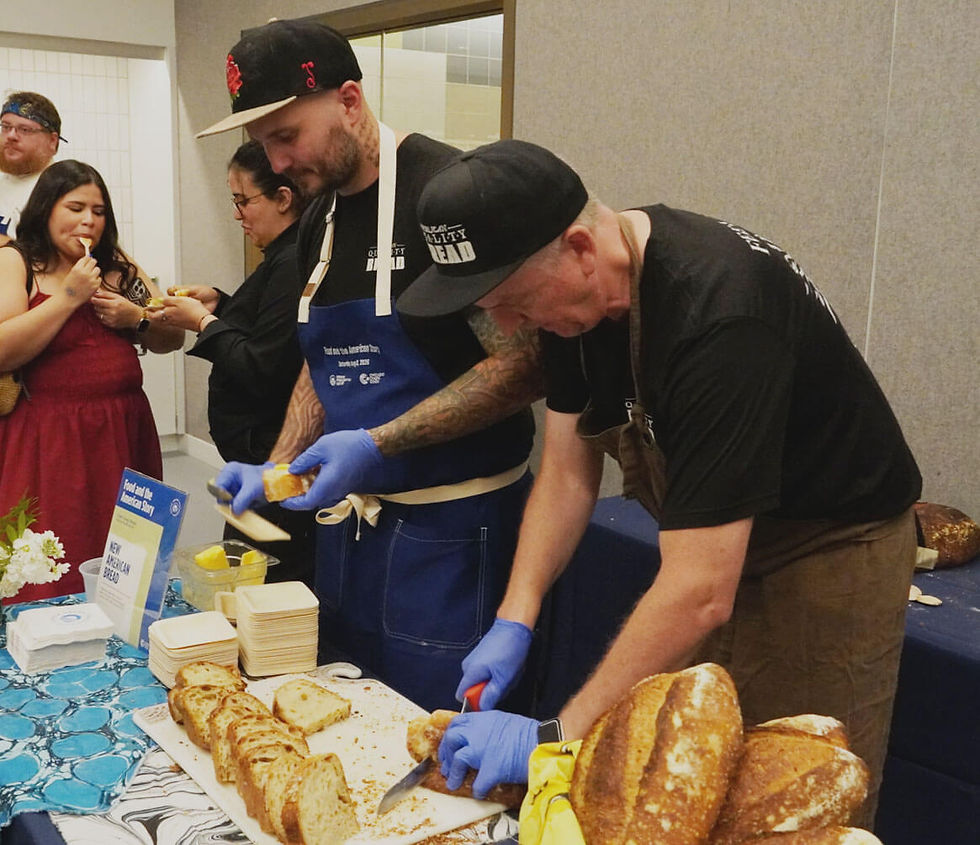
The tasting that followed was therefore more than an opportunity to sample dishes, prepared by accomplished Chicago chefs, that reflect the experiences of Black Americans. It continued the conversation.
Every bite carried some version of a story about movement, adaptation, survival and home. And that may have been the evening’s most important lesson.
The tasting was a partnership between the Center and Chicago Chefs Cook, the non-profit organization that since 2022 has emerged as the premier expression of our culinary community’s philanthropic passions.
The photos below show the participating chefs at work feeding hundreds of attendees, many of whom were undoubtedly inspired by the preceding conversation. All chefs work in the city of Chicago unless otherwise noted.




Comments