.png)


A Leading History Museum is Fueling the Farm-to-School Movement

The Henry Ford Held a Discussion and Film Screening in Chicago March 24

The Henry Ford non-profit organization is best know for its Henry Ford Museum of American Innovation in Dearborn, Michigan, where the historic exhibits include Thomas Edison’s invention laboratory and the garage where Henry Ford built his first automobiles.
But the organization presents a wide range of public-spirited programming — which includes an Edible Education program and its Farm to School Lunch Across America campaign.
Evolved from The Henry Ford’s experience in elevating the quality and nutrition of meals at the high school located on the museum’s campus, the Farm to School Lunch Across America program staged a tour in autumn 2024 that visited schools in Chicago, Minneapolis, the California cities of Berkeley and Richmond, and Lincoln Park, Michigan.
The series has spawned a documentary film about the experience that was screened March 24 at a special event at Chicago’s Gene Siskel Film Center. A follow-up article about the film — which has not yet been released to the public will follow soon.
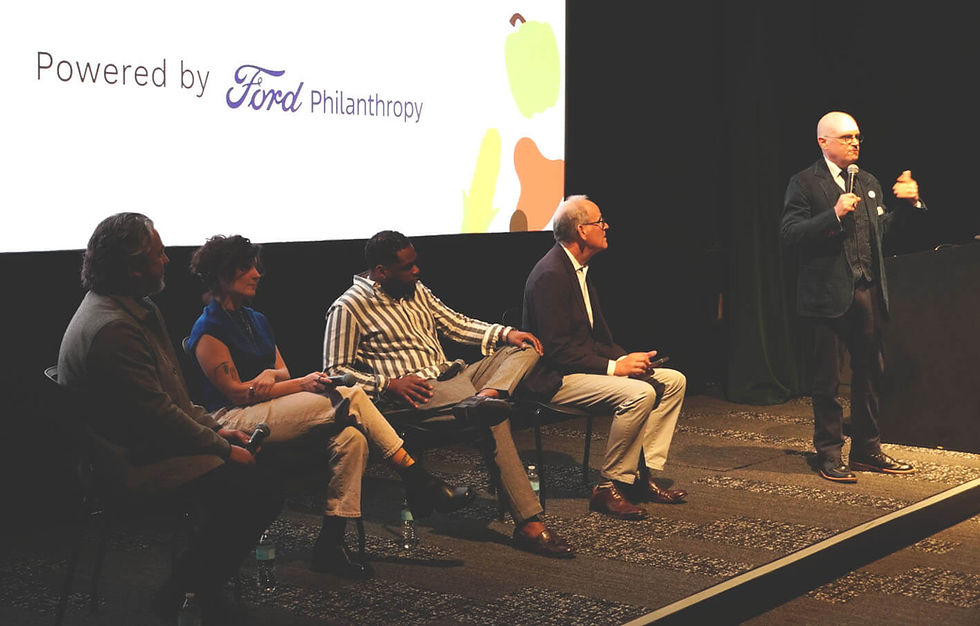
The screening was preceded by a panel discussion with participants who had taken part in the Chicago leg of the 2024 School Lunch across America program:
* Alan Shannon, a longtime former official with the U.S. Department of Agriculture who serves as a consultant to The Henry Ford project, who moderated the discussion.
* Spence Medford , Senior Vice President and Chief Advancement Officer at The Henry Ford.

* Chef Sebastian White of founder of The Evolved Network non-profit, which provides food education, cooking lessons and life skills to unprivileged students.
* Kris de la Torre, managing director for Cultivate Collective, an offshoot of Academy for Global Citizenship, an innovative charter school with strong emphases on sustainability and food.
* Chef Matthias Merges, founder/president of Folkart Restaurant Management and the Irving Park Food Group, who is also a co-founder of the Pilot Light food education program.
The conversation, though brief, offered a powerful window into a growing national movement: reimagining school meals not just as a nutritional service, but as a lever for community health, environmental sustainability and social connection. Each speaker brought a distinct perspective, but together they painted a cohesive picture of both the promise and the complexity of transforming school food systems.
The Henry Ford: Exhibiting Storytelling as Strategy
At first glance, The Henry Ford might seem like an unlikely leader in school food innovation. But as Spence Medford explained, the institution’s core mission is not just preservation, but storytelling and convening around American innovation.
That mission has expanded to include food systems. During the COVID-19 pandemic, The Henry Ford launched initiatives tied to agriculture, climate and education, including an urban farmers market and reforms to its own school lunch program. These efforts raised a fundamental question: How can school meals could do more in areas such as:
Eliminating ultra-processed foods
Supporting local and regenerative farmers
Removing stigma by making school meals free for all students
Use food as an educational tool
From there, the organization scaled outward with The Farm to School Lunch Across America tour, launched in October 2024 during National Farm to School Month, to document and amplify local innovation.
Spence emphasized that the resulting documentary is not an endpoint, but a “conversation starter” — a tool to connect communities that are often working in isolation. The central insight: many regions are doing exceptional work but lack access and visibility into one another’s models.
Policy Backdrop: From Controversy to Consensus

Alan Shannon grounded the discussion in policy history. During the Obama administration, federal efforts to improve school meal nutrition — championed by then First Lady Michelle Obama’s Let’s Move! Initiative — faced surprising resistance.
At the time, even modest changes such as increasing fruits and vegetables in school meals sparked political pushback. Today, Alan noted, the landscape has shifted toward bipartisan support. School meals are increasingly recognized as essential infrastructure, critical not only for child nutrition but for educational outcomes and public health.
This evolution creates a rare window of opportunity. While public demand for better food is building greater political will, implementation challenges remain.
The “Why”: Personal Pathways into Food Justice
Each panelist articulated a deeply personal motivation for engaging in school food work, underscoring that this movement is driven as much by values as by policy.

Chef Sebastian White: Food as Therapy and Identity
For Sebastian, the journey began with family and evolved into a philosophy centered on what he calls the “therapeutic power of farm-to-table.” This approach is grounded in his first career as a clinical psychologist who worked with at-risk youths in Waukegan, Illinois.
His agenda goes beyond nutrition to focus on dignity, self-perception and emotional connection. He described how meals communicate value to children, and how the care embedded in food preparation can shape how young people see themselves and their potential.

Kris de la Torre: Community Care and Beauty
Kris framed her work around two core values:
Community care: Food as a foundational social practice that binds people together
Beauty: Farms and food systems as spaces of inspiration, deserving the same reverence as cultural institutions
She challenged the societal tendency to undervalue food labor — from farmers to cafeteria workers — despite its essential role in sustaining communities.

Chef Matthias Merges: Giving Back Through Food Education
For Matthias, the motivation is rooted in service. His early involvement in his daughters’ school led to hands-on food education experiences — introducing students to ingredients and cooking in ways that sparked curiosity.
That grass-roots engagement eventually helped inspire Pilot Light, a nationally recognized program founded in 2010 that integrates food education into K–12 classrooms and has crafted food education standards that are in use by many school systems across the nation.
Matthias emphasized a long-term vision: equipping students to become informed, empowered decision-makers around food.
The Front Lines: Challenges in School Food Systems
While the vision is expansive, the operational reality of school meals is complex.
Kris de la Torre highlighted the regulatory and logistical barriers faced by public school food programs:
Extensive compliance requirements
Tight budgets requiring precision spending
Infrastructure limitations
Workforce constraints
These challenges often restrict the ability to serve fresh, locally sourced meals, even when there is strong desire to do so.
Yet within these constraints, Kris sees constant innovation. Cafeteria workers and food service staff, she stated, are “problem solvers” operating under pressure, finding creative ways to improve meal quality despite systemic limitations.
Importantly, many of these workers are deeply embedded in their communities —parents, neighbors and caregivers who understand the stakes of their work firsthand.
Rethinking the Language of Food
One of the most provocative threads in the discussion came from Sebastian White, who challenged commonly used terms like “healthy” and “sustainable.”
The Problem with “Healthy”
Sebastian suggested that labeling food as “healthy” can unintentionally create hierarchies and alienate students:
It can imply judgment on what is “good” versus “bad”
It may conflict with lived experiences and cultural foodways
It can make food feel transactional rather than relational
In practice, he finds that simply serving thoughtfully prepared, visually appealing meals using quality ingredients allows students to form their own positive associations, without the need for prescriptive language.
The Limits of “Sustainability”
Similarly, Sebastian noted that the concept of sustainability can feel abstract or irrelevant to students facing immediate challenges. If a young person feels marginalized in their current environment, the idea of “sustaining” that environment may not resonate.
Instead, he advocates for framing food as a source of hope, creativity, agency amd connection. This reframing shifts the focus from obligation to possibility.
Schools as Community Anchors
Across the discussion, a consistent theme emerged: Schools are uniquely positioned to drive systemic change.
School meal programs intersect with multiple domains:
Public health: Addressing nutrition and food security
Education: Enhancing learning and engagement
Local economies: Supporting regional agriculture
Climate: Encouraging sustainable practices
Because of this reach, even incremental improvements can have outsized impact.
Matthias described how food education initiatives can ripple outward, with students bringing new ideas home, influencing family habits, and eventually shaping broader cultural norms.
From Awareness to Action: What Individuals Can Do
In closing, the panelists offered practical guidance for audience members seeking to support school meal initiatives.
1. Get Involved Locally
Matthias encouraged participation in Local School Councils (LSCs) or partnerships with organizations like Pilot Light. Direct engagement with schools is often the most effective entry point.
2. Listen to Students
Sebastian emphasized the importance of centering student voices. Children, he argued, have clear preferences and insights — and adults simply need to take them seriously.
3. Support School Food Workers
Kris urged attendees to build relationships with cafeteria staff:
Learn their stories
Understand their challenges
Ask what resources they need
Support can take many forms: time, advocacy, or simply encouragement.
Conclusion: A Movement Built on Connection
The panel made clear that transforming school meals is not just a technical challenge — it is a cultural one. It requires rethinking how society values food, labor and community.
The Henry Ford’s initiative demonstrates the power of storytelling to bridge gaps between communities, while the experiences shared by Chicago’s practitioners highlight the importance of local action.
At its core, the farm-to-school movement is about connection:
Between students and their food
Between schools and local farmers
Between policy and lived experience
As the documentary aims to show, the path forward is not about a single solution, but about amplifying what works, learning across communities and recognizing that even something as everyday as a school lunch can be a catalyst for profound change.


It’s amazing to see how museums are supporting the farm-to-school movement and helping students learn more about nutrition, local food systems, and community awareness. A lot of people today also rely on proper online guidance for important processes related to education, jobs, and travel.
For example, many Filipinos search for updated NBI Requirements Online before applying for work or planning opportunities abroad so they can avoid delays and prepare their documents correctly. Initiatives like these really show how access to the right information can make everyday processes much easier for communities.